How to Spot Value Bets in Football Markets
Introduction
Value betting is the cornerstone of long-term profitability in sports betting. It is not about picking winners every time – it is about identifying situations where the odds offered by a bookmaker are higher than the true probability of the outcome.
When you find a value bet, you are essentially getting a price that underestimates the chances of an event happening. Over many bets, consistently finding value should lead to profit, even if individual bets lose.
This guide explains what value is, how to calculate it, and most importantly, how to spot value bets in football markets. It covers the relationship between odds and probability, the importance of independent analysis, common situations where value can appear, and the tools and mindset you need to exploit them.
The objective is not to promise guaranteed profits, but to provide a structured approach to identifying opportunities that the market may have overlooked.
1. What Is a Value Bet?
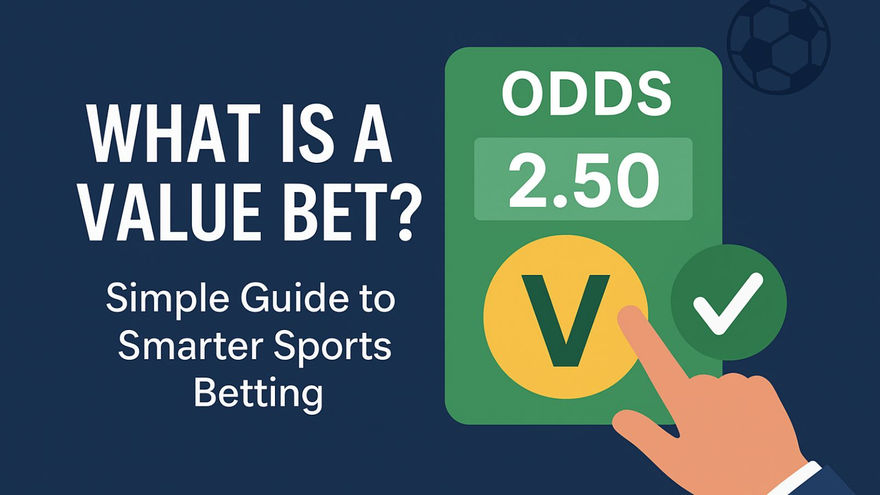
A value bet exists when the probability of an outcome occurring is greater than the probability implied by the odds. In simple terms, the odds are higher than they should be.
For example, if you estimate that a team has a 50% chance of winning, the fair odds would be 2.00. If a bookmaker offers odds of 2.20, that is a value bet because the implied probability is only 45.5%, but your estimate is 50%.
Value is not about whether a bet wins or loses. It is about the relationship between the price and the true probability. A value bet can lose, and a non-value bet can win. Over the long run, however, consistently betting on value should yield a profit.
2. The Relationship Between Odds and Probability
To spot value, you must understand how odds translate into probability. As covered in our Betting Odds Guide, the implied probability is calculated by dividing 1 by the decimal odds.
Implied Probability = 1 / Decimal Odds
For example:
- Odds 2.00 → 1 / 2.00 = 50%
- Odds 3.00 → 1 / 3.00 = 33.3%
- Odds 4.00 → 1 / 4.00 = 25%
Your task is to estimate the true probability of the outcome yourself, using analysis. If your estimated probability is higher than the implied probability, there may be value.
3. Expected Value (EV)
Expected value is a more precise way to quantify value. It tells you how much you can expect to win (or lose) on average for each bet.
EV = (Probability × Decimal Odds) − 1
If EV is positive, the bet has value. If negative, it does not.
Example: You estimate a team has a 50% chance of winning. The odds are 2.20.
EV = (0.50 × 2.20) − 1 = 0.10 = +10%
This means that for every £1 staked, you expect a long-term profit of 10p.
Understanding EV helps you compare bets objectively and prioritise those with the highest expected value.
4. The Importance of Independent Analysis
Value betting requires you to have an opinion that differs from the market. If your estimated probability is the same as the implied probability, there is no value.
To form your own estimate, you need to analyse football matches thoroughly. This includes:
- Recent form and performances
- Expected goals (xG) and xGA
- Home and away records
- Team news, injuries and suspensions
- Tactical matchups
- Fixture congestion and rest days
- Motivation and context
Our guide How to Analyze Football Matches Like a Professional provides a structured framework for this.
The more accurate your probability estimates, the more likely you are to find genuine value.
5. Common Sources of Value
Value can appear in various situations. Here are some common sources:
Public Bias
Bookmakers often adjust odds based on public opinion. If a popular team is overbacked, their odds may shorten, creating value on the opponent or other markets.
Overreaction to News
Injuries, suspensions, or a poor recent result can cause odds to swing too far. If the market overreacts, there may be value on the other side.
Smaller Leagues
Bookmakers may have less information and lower liquidity in smaller leagues, leading to less efficient odds and more value opportunities.
Specific Markets
Markets like corners, cards, or player shots can be less efficiently priced than the main 1X2 market, offering potential value for those who analyse them.
Live Betting
During a match, odds change rapidly. A team may go a goal down but still be playing well, creating value if the market overreacts to the scoreline.
6. Tools for Finding Value
Several tools can help you spot value:
- Odds comparison sites: Compare odds across bookmakers to find the best price. Even a small difference can turn a negative EV bet into a positive one.
- Expected goals (xG) data: Use xG to assess underlying performance and identify teams that are under- or over-performing.
- Betting exchanges: Exchanges like Betfair can provide a more accurate reflection of true probability, as they are peer-to-peer markets with lower margins.
- Statistical models: Some bettors build their own models to estimate probabilities. This requires significant expertise but can be highly effective.
7. The Role of Bookmaker Margin
Bookmakers build a margin into their odds, which means the total implied probability of all outcomes exceeds 100%. This margin is their profit.
To find value, you must overcome this margin. Your estimated probability must be higher than the implied probability after accounting for the margin. This is why finding value is challenging – the market is designed to be efficient.
However, inefficiencies do exist, especially in less popular markets and leagues.
8. Avoiding Common Mistakes
Many bettors think they have found value when they have not. Common mistakes include:
- Confusing high odds with value: High odds mean low probability, not necessarily value.
- Overestimating your edge: Being overconfident in your analysis can lead to false value.
- Ignoring the margin: Not accounting for the bookmaker's cut.
- Chasing losses: Betting on value is about long-term profit, not recovering losses quickly.
- Not shopping around: Using only one bookmaker limits your ability to find the best price.
Avoiding these mistakes requires discipline and a clear understanding of probability.
9. Value Betting in Practice
Let’s walk through a hypothetical example.
You analyse a match and estimate that Team A has a 45% chance of winning. The bookmaker offers odds of 2.50 for a Team A win.
Implied probability = 1 / 2.50 = 40%.
Your estimated probability = 45%.
EV = (0.45 × 2.50) − 1 = 0.125 = +12.5%.
This is a value bet. Even though Team A is not the favourite, the odds offer a positive expected value.
Now imagine the odds were 2.00. Implied probability = 50%. Your estimate is 45%, so EV = (0.45 × 2.00) − 1 = −0.10 = −10%. This is not a value bet.
The key is to consistently compare your estimated probability with the implied probability.
10. Bankroll Management and Value Betting
Even with a value bet, you must manage your bankroll properly. Not every value bet will win, and losing streaks are inevitable. Using a staking plan like flat betting or percentage betting (as discussed in our Bankroll Management guide) helps you survive variance and capitalise on value over the long term.
Never bet more than you can afford to lose, and never chase losses.
11. Responsible Gambling
Value betting is a skill, but it is not a guaranteed path to profit. The market is efficient, and finding value requires hard work and discipline. Always bet responsibly and within your means.
18+ Only. Gamble Responsibly.
Final Thoughts
Spotting value bets is about having a better understanding of true probability than the market. It requires independent analysis, a clear understanding of odds and expected value, and the discipline to bet consistently.
While it is not easy, value betting is the most rational approach to sports betting. By focusing on value rather than simply picking winners, you give yourself the best chance of long-term success.
Remember, value is not about winning every bet – it is about making profitable decisions over time.